Key takeaways
- Cost depends on features, design depth and integrations, not just page count.
- Brochure sites, e-commerce stores and custom web apps are three very different projects.
- Plan for ongoing costs: hosting, security, maintenance and content.
- A clear one-page brief gets you better, more comparable quotes.
The three types of website projects
Most quotes make sense once you know which of these you are buying.
| Type | Typical examples | What drives the cost |
|---|---|---|
| Business or brochure website | Company, clinic, consultant or portfolio site | Design quality, number of unique page layouts, content and SEO |
| E-commerce store | Online shop with catalogue and checkout | Products, payments, shipping, tax invoicing and integrations |
| Custom web application | Booking system, portal, dashboard or SaaS product | Features, user roles, integrations, security and scale |
What actually moves the price
- Design: a customised template costs less than a fully custom design and prototype.
- Unique layouts, not pages: fifty product pages built from one layout cost far less than ten pages that each need a new design.
- Features and integrations: payment gateways, CRM, WhatsApp, maps, booking and third-party APIs each add build and testing time.
- Admin and CMS needs: the more your team wants to edit without a developer, the more is built behind the scenes.
- Content: writing, photography and translation are often separate from development.
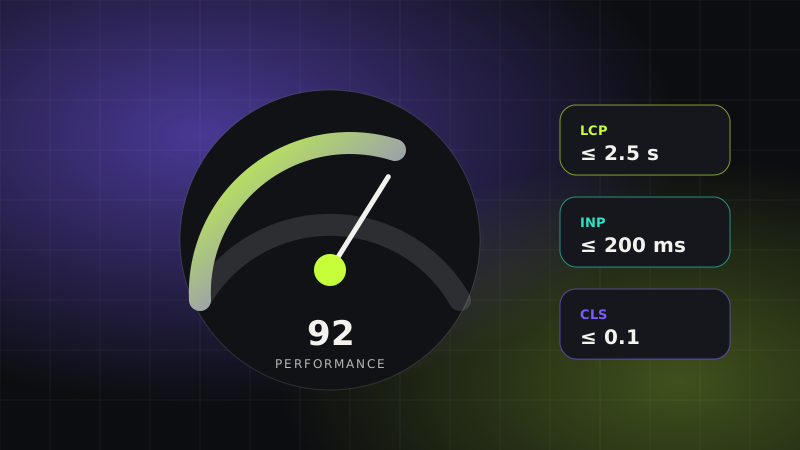
- SEO and performance: fast pages, clean structure and schema markup take planning from the start.
- Security and compliance: login, payments and personal data need extra care.
- Timeline and team: tight deadlines and larger teams change the cost model.
Costs people forget
- Domain name and hosting, renewed every year.
- SSL certificate and security monitoring.
- Updates, backups and bug fixes after launch.
- Content refreshes and new features as the business grows.
- Marketing and SEO to bring visitors to the site.
Fixed price or monthly team?
A fixed-scope project suits a clearly defined website. A monthly team suits a product that keeps evolving. We compare both models in Dedicated Team vs Fixed-Price Project.
How to get an accurate quote
- Write one paragraph describing the goal: who the site is for and what you want visitors to do.
- List three websites you like and say why.
- List the must-have features and the nice-to-haves separately.
- Decide who will provide text, images and branding.
- Share your timeline and a budget range so the proposal fits it.
- Ask for milestones and what is included after launch.
Frequently asked questions
Why do website quotes vary so much?
Because the scope behind them differs: custom design versus a template, number of integrations, admin features, content, testing and post-launch support. Compare what is included, not just the total.
Can I start small and expand later?
Yes. Launching a focused first version (an MVP) and adding features based on real use is often cheaper and lower risk than building everything at once.
Is a cheaper template website good enough?
For many small businesses, yes. If you need unique branding, custom features or strong performance and SEO, a custom build is usually worth it.